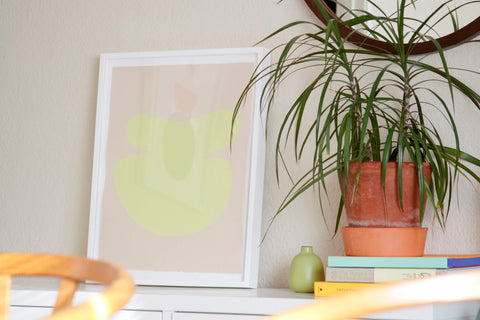
Lines and Half Moons
Regular price$610.00
/
Two color silkscreen print.
Edition of 20
20" x 14" / 50.8cm x 35.5cm
Bold, high-contrast geometric forms define the surface of Dering's vessels and tableware; a visual language that emerges from deep technical fluency with clay rather than decorative instinct. These three prints isolate and amplify that graphic language, translating her glazed surface treatments into silkscreen through careful ink layering and crisp registration.
About The Artist
Zoe Dering began working with clay in 2008 and currently splits her time between ceramics and working as a professional pastry chef. These dual pursuits are in many ways connected; there is a science that must be adhered to before one can move on to finding freedom within either of the two mediums.
Read More
Read More
For this series we’ve titled Sculptural Organic, a group of 18 silkscreen prints have been editioned that draw on research into the history and ethos of the Mexican Functionalists.
The Functionalists were a group of architects and designers working during the 1930s that included Juan O’Gorman and Juan Legarreta. Their designs embraced an “economy of materials”. Their spaces worked to avoid any material ‘camouflage’ and instead celebrated the inherent simplicity and beauty of brick, wood and natural stone.
The Mexican Functionalists focused on sympathetic relations between building and site, and an interest in finding ways to expose the raw textures and make a feature of unadorned surfaces and building materials. The philosophy of the Mexican Functionalist was also to eschew the display of decorative objects and artworks in their living spaces instead favoring the display of everyday, useful objects such as ceramic cups, vessels and serving bowls.
It is this aspect of their design philosophy that inspired this series; across all of the prints, ceramic processes, the materiality of clay and its elemental makeup of earth and water act as a key touch-points.
A small group of ceramicists based in California (Zoe Dering and Donna DeSoto), New Mexico (Natan Moss) and Mérida, Mexico (Eugenia ‘Uxii’ Diaz) were invited to work as project collaborators. These artists primarily produce functional ceramic objects - vessels, serving ware, furniture - and from their designs and surface techniques, the series of prints was produced. As a collection, these works tell a rich story inspired by material, process, history and design.
The Functionalists were a group of architects and designers working during the 1930s that included Juan O’Gorman and Juan Legarreta. Their designs embraced an “economy of materials”. Their spaces worked to avoid any material ‘camouflage’ and instead celebrated the inherent simplicity and beauty of brick, wood and natural stone.
The Mexican Functionalists focused on sympathetic relations between building and site, and an interest in finding ways to expose the raw textures and make a feature of unadorned surfaces and building materials. The philosophy of the Mexican Functionalist was also to eschew the display of decorative objects and artworks in their living spaces instead favoring the display of everyday, useful objects such as ceramic cups, vessels and serving bowls.
It is this aspect of their design philosophy that inspired this series; across all of the prints, ceramic processes, the materiality of clay and its elemental makeup of earth and water act as a key touch-points.
A small group of ceramicists based in California (Zoe Dering and Donna DeSoto), New Mexico (Natan Moss) and Mérida, Mexico (Eugenia ‘Uxii’ Diaz) were invited to work as project collaborators. These artists primarily produce functional ceramic objects - vessels, serving ware, furniture - and from their designs and surface techniques, the series of prints was produced. As a collection, these works tell a rich story inspired by material, process, history and design.
Our typical framing practice is to float mount prints with 1-inch (2cm) of space around the print. This is a method of framing that keeps the art fully visible in the frame and leaves the edges of the cotton papers exposed. A spacer is added to the frame to keep the artwork from touching the plexiglass. Float mounting requires adhering the print to an acid free foam core back or mat board using acid free linen tape.
UV-filtering plexiglass is used for all frames, an option that has become the industry standard. Plexiglass is lighter, scratch-resistant & shatter-resistant (essential for shipping). It also provides more UV protection and less glare than glass.
Please note that Premium Framing options are currently only available to US clients. For clients in Australia, please email us and we can share framing recommendations based on your location. More information about Custom Framing
UV-filtering plexiglass is used for all frames, an option that has become the industry standard. Plexiglass is lighter, scratch-resistant & shatter-resistant (essential for shipping). It also provides more UV protection and less glare than glass.
Please note that Premium Framing options are currently only available to US clients. For clients in Australia, please email us and we can share framing recommendations based on your location. More information about Custom Framing