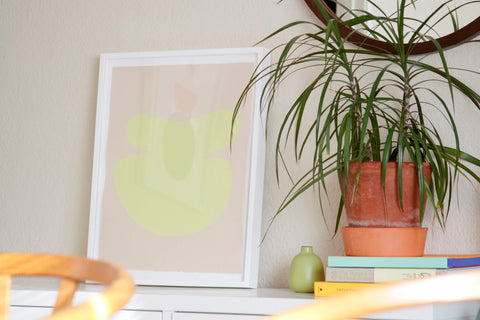
Surface: Oblique Vessel (Projection)
Regular price$1,105.00
/
Eight color silkscreen print with airbrush detail
Edition of 35
22" x 28" / 55.9cm x 71.1cm
Hoyt placed two finished ceramic vessels directly onto a scanner bed and captured their inlaid patterned surfaces in exact detail. What started as clay became print; two processes that share the same logic of building a surface one color at a time.
About The Artist
Cody Hoyt (b. 1980) holds an BFA in printmaking from Massachusetts College of Art. He has exhibited in the US and abroad, including galleries such as Patrick Parrish, David Gill, UNTITLED Art fair and Design Miami. Drawing on his educational background in printmaking Hoyt has since turned his attention to producing work in ceramic and is now an incredibly skillful, self-taught master of the medium.
Read More
From a pair of prints that originate from digital scans that Hoyt made from two of his finished vessels; placing each side directly onto the surface of the scanner bed and capturing faithfully their patterned inlaid surfaces.
Hoyt’s angular vessels are first created as cardboard prototypes, a process through which he can experiment with different potentials for form and balance. From these cardboard studies, he can create a flat net of the eventual vessel that will provide a guide as he begins to roll out his intricately patterned clay flats. The rolled flats of clay are folded up to form the walls of his vessels; a process that takes literally the idea of surface becoming form.
The patterned surface of the rolled flats are generated through the use of masonry colors to dye the clay numerous different hues, then either sandwiched together, marbled or sliced up and inlaid together and flatten through the clay roller. The technique of combining separate colors to create a patterned surface is reminiscent of the process of singular color application inherent to silkscreen printing, linking the production techniques between our two studios.
Hoyt’s angular vessels are first created as cardboard prototypes, a process through which he can experiment with different potentials for form and balance. From these cardboard studies, he can create a flat net of the eventual vessel that will provide a guide as he begins to roll out his intricately patterned clay flats. The rolled flats of clay are folded up to form the walls of his vessels; a process that takes literally the idea of surface becoming form.
The patterned surface of the rolled flats are generated through the use of masonry colors to dye the clay numerous different hues, then either sandwiched together, marbled or sliced up and inlaid together and flatten through the clay roller. The technique of combining separate colors to create a patterned surface is reminiscent of the process of singular color application inherent to silkscreen printing, linking the production techniques between our two studios.
Our typical framing practice is to float mount prints with 1-inch (2cm) of space around the print. This is a method of framing that keeps the art fully visible in the frame and leaves the edges of the cotton papers exposed. A spacer is added to the frame to keep the artwork from touching the plexiglass. Float mounting requires adhering the print to an acid free foam core back or mat board using acid free linen tape.
UV-filtering plexiglass is used for all frames, an option that has become the industry standard. Plexiglass is lighter, scratch-resistant & shatter-resistant (essential for shipping). It also provides more UV protection and less glare than glass.
Please note that Premium Framing options are currently only available to US clients. For clients in Australia, please email us and we can share framing recommendations based on your location. More information about Custom Framing
UV-filtering plexiglass is used for all frames, an option that has become the industry standard. Plexiglass is lighter, scratch-resistant & shatter-resistant (essential for shipping). It also provides more UV protection and less glare than glass.
Please note that Premium Framing options are currently only available to US clients. For clients in Australia, please email us and we can share framing recommendations based on your location. More information about Custom Framing