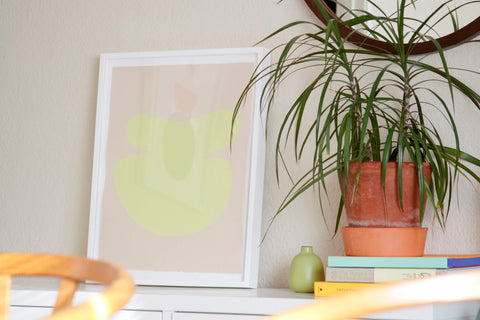
Tallman ID Table, Fall Foray
Regular price$230.00
/
One color silkscreen print
Edition of 20
30" x 22" / 76.2cm x 55.9cm
Nine artists were asked to share personal photographs taken outdoors, not while making work, but while simply being somewhere. What came back became a panorama of collective creative experience, printed in single colours as silkscreen editions. Each print is a suspension of someone else's free time.
About The Artist
Angelina Gualdoni is a painter working in the genre of still life and interiors. Through use of dyeing, pouring, staining and historic textile patterning, she links various women’s creative practices from industrial to domestic, decorative to metaphysical.
Read More
From a collaborative project and exhibition The Mind is Also a Landscape, presented at Public Land in Sacramento (November 16, 2019 - January 15, 2020). The project featured the work of nine contemporary artists whose varied practices encompass painting, sculpture, printmaking, performance and writing.
Among the group, several artists produce work that is discernibly influenced by or produced in concert with the natural world, while for others that relationship is less direct. What is shared is the impulse to be drawn out from the familiar interior of the studio into a freer, less personal landscape of the natural world and to be receptive to its surprises and liberations.
From each artist, we requested they share personal photographs from periods of ‘free time’ spent in the outdoors, not engaged in the act of ‘making’ or ‘doing’ but in receptive exploration. We then reproduced a selection of those images in large format as single-color silkscreen prints which, when installed, built a kind of panorama of collective creative experiences undertaken outside of their typical, urban environment in disparate natural locations.
In her seminal book Wanderlust: A History of Walking writer Rebecca Solnit proposes that nature can behave as a pace as well as a place. The pace of a person walking allows the natural world to introduce a new time metric, one that is inherently bodily. In many ways The Mind is Also a Landscape offers its own meditation on time; The seasonal and geological time of landscape; The suspension of time within the camera’s frame; The symbiotic relationship of the artists’ time spent inside and outside the space of studio production. To the viewer, the exhibition proposes a consideration of how the natural environment influences artists in immeasurable ways and by extension how it influences all of our lives, our imagination and our wellbeing.
Among the group, several artists produce work that is discernibly influenced by or produced in concert with the natural world, while for others that relationship is less direct. What is shared is the impulse to be drawn out from the familiar interior of the studio into a freer, less personal landscape of the natural world and to be receptive to its surprises and liberations.
From each artist, we requested they share personal photographs from periods of ‘free time’ spent in the outdoors, not engaged in the act of ‘making’ or ‘doing’ but in receptive exploration. We then reproduced a selection of those images in large format as single-color silkscreen prints which, when installed, built a kind of panorama of collective creative experiences undertaken outside of their typical, urban environment in disparate natural locations.
In her seminal book Wanderlust: A History of Walking writer Rebecca Solnit proposes that nature can behave as a pace as well as a place. The pace of a person walking allows the natural world to introduce a new time metric, one that is inherently bodily. In many ways The Mind is Also a Landscape offers its own meditation on time; The seasonal and geological time of landscape; The suspension of time within the camera’s frame; The symbiotic relationship of the artists’ time spent inside and outside the space of studio production. To the viewer, the exhibition proposes a consideration of how the natural environment influences artists in immeasurable ways and by extension how it influences all of our lives, our imagination and our wellbeing.
Our typical framing practice is to float mount prints with 1-inch (2cm) of space around the print. This is a method of framing that keeps the art fully visible in the frame and leaves the edges of the cotton papers exposed. A spacer is added to the frame to keep the artwork from touching the plexiglass. Float mounting requires adhering the print to an acid free foam core back or mat board using acid free linen tape.
UV-filtering plexiglass is used for all frames, an option that has become the industry standard. Plexiglass is lighter, scratch-resistant & shatter-resistant (essential for shipping). It also provides more UV protection and less glare than glass.
Please note that Premium Framing options are currently only available to US clients. For clients in Australia, please email us and we can share framing recommendations based on your location. More information about Custom Framing
UV-filtering plexiglass is used for all frames, an option that has become the industry standard. Plexiglass is lighter, scratch-resistant & shatter-resistant (essential for shipping). It also provides more UV protection and less glare than glass.
Please note that Premium Framing options are currently only available to US clients. For clients in Australia, please email us and we can share framing recommendations based on your location. More information about Custom Framing